
Do your necklaces look stylish in the jewelry tray but crowded once you put them on? That usually happens because the chains sit at the same height, the pendants compete for attention, or the metals lack one detail that ties them together. A polished stack does not require a large jewelry collection. It needs clear spacing, one visual anchor, and enough empty skin between each piece.
Why necklace layers look polished or messy
Spacing creates the shape
The eye reads a necklace stack as a vertical line. If two pendants land on the same spot, that line breaks and the pieces look accidental. A useful starting point is a 2-inch gap between the lowest point of one necklace and the lowest point of the next. For a simple three-piece stack, try a 16-inch chain, an 18-inch chain, and a 20- or 22-inch pendant. The exact lengths can change with your neck and neckline, but the visual gap should stay clear.
Contrast gives each piece a job
Three delicate gold chains can disappear into one thin stripe. Three heavy chains can make a soft blouse look weighed down. The strongest combination usually mixes roles: a slim choker or collar as the frame, a medium chain for texture, and one pendant as the focal point. Keep only one necklace visually loud. A polished stack has a hierarchy, so the viewer knows where to look first.
My verdict: start with two necklaces, not four. Add a third only when the first two have different lengths and different visual weight. This rule fixes most crowded stacks before you buy anything new.
The four measurements that make layers sit right
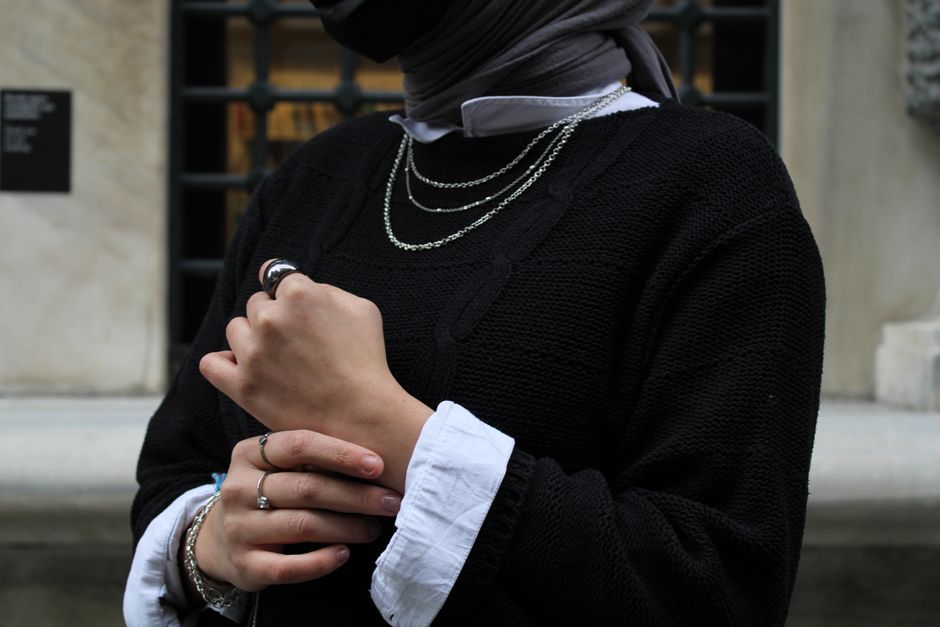
Necklace layering becomes much easier when you measure the outfit before choosing jewelry. Use this order every time:
- Measure the neckline. A crew neck leaves less visible skin than a V-neck, so a 16-inch chain may sit on top of the fabric while an 18-inch chain disappears beneath it. For a crew neck, begin with 18 inches. For a low V-neck, use 16, 18, and 20 inches to follow the opening.
- Set the shortest piece. The first necklace should sit close to the base of your neck without pressing into it. A 14- to 16-inch chain works for a close frame, but choose the longer option if you dislike a snug fit.
- Keep pendant drops separate. If a pendant hangs 2 inches below its chain, count that drop when planning the next layer. A 18-inch pendant can visually reach the same point as a plain 20-inch chain.
- Check the clasp and extender. Extenders add about 2 inches of flexibility, but they can show at the back of the neck. Place the extender to one side before dressing, then turn the clasp toward the least visible shoulder.
A quick mirror test
Put on the top you plan to wear, then place each necklace one at a time. Take a phone photo from chest height. The camera reveals overlaps that a close mirror can hide. If two chains touch in the photo, move one up or down by at least 1.5 inches.
Best rule: plan the stack from the neckline outward. Jewelry chosen first often forces the outfit into an awkward shape.
Which necklace types work best together?
The best stack combines different functions, not random pieces. These examples show how length, texture, and pendant size change the result. Product names are useful references for shape, but you do not need the exact item to copy the formula.
| Layer role | Useful length | Style example | Best pairing |
|---|---|---|---|
| Close frame | 14–16 inches | Catbird Sweet Nothing Chain, 16-inch style | Long pendant with a clean drop |
| Everyday texture | 18 inches | Mejuri Bold Chain Necklace, 18-inch option | Fine chain or small charm |
| Visual anchor | 20–22 inches | Missoma Axiom Chain Necklace, 20-inch style | Shorter plain chains |
| Mixed-metal accent | 16–18 inches | Ana Luisa Figaro Chain, 16-inch style | Yellow-gold or silver pendant |
Choose the middle layer carefully
The middle necklace controls the mood. A curb or Figaro chain feels sharper and more modern; a fine cable chain looks quieter; a beaded strand adds a softer, more relaxed note. The Mejuri Bold Chain Necklace makes the strongest middle layer for a plain white shirt because its links add texture without needing a pendant.
When a statement piece should stand alone
The Tiffany HardWear Link Necklace or another large-link design deserves space around it. Do not place two bold chains beside it and call that balance. For a dramatic necklace, use one thin 16-inch chain above it or skip the upper layer entirely. For most work outfits, the Catbird and Mejuri pairing is the clear winner because it looks intentional without taking over the neckline.
The fastest fix for a tangled or crowded stack

If your necklaces twist together after ten minutes, remove the piece with the smallest links first, because fine chains catch on both clasps and textured surfaces, then check that the lengths differ by at least 2 inches from chain to chain; a 16-inch necklace beside an 18-inch necklace often needs an extender, while a 16-inch necklace beside a 20-inch pendant usually has enough separation to move cleanly.
If the stack still bunches, reduce the number of pendants to one, spread the chains across different collarbone points, and turn the largest clasp toward the back before you leave the house; a simple chain connector can hold several necklaces together at the clasp, but it cannot fix poor length spacing or a pendant that lands directly on another pendant.
The practical verdict is simple: tangling is usually a layout problem, not proof that you need expensive anti-tangle jewelry, so test the stack with a safety pin or temporary connector at home, walk around for five minutes, and keep the combination that stays separated while you move; for daily wear, two chains with one pendant beat a four-piece stack that needs constant adjustment.
Necklace-layering questions shoppers ask
Can you mix gold and silver necklaces?
Yes, but one metal needs to lead. Use two gold pieces and one silver accent, or two silver pieces and one gold accent. A mixed-metal connector, watch, ring, or pair of earrings can repeat the accent and make it look planned. Randomly alternating gold and silver at every layer creates visual noise.
How many necklaces should you layer?
Three is the most useful maximum for everyday outfits. Two works best with a busy print, high neckline, or large earrings. Four can work for a deliberately eclectic look, but each necklace needs a separate length and a different texture. If you cannot identify the role of one piece, remove it.
Should all necklace pendants match?
No. They should share one connection, such as the same metal, a related stone color, or a repeated shape. A tiny initial beside a small geometric charm looks neat because the scale stays controlled. Two large symbols compete, especially when they hang within 1 inch of each other.
What should you avoid with a turtleneck?
Short delicate chains often vanish against thick knit fabric. Choose one long pendant at 24 to 30 inches, or wear a bold chain that sits visibly over the knit. The strongest choice for a turtleneck is one clear necklace, not several narrow layers trying to break through the fabric.
My answer: choose fewer pieces when the clothing already has strong texture, color, or volume. The jewelry should clarify the outfit, not compete with it.
The polished formula I recommend for 2026

My strongest recommendation is a three-step stack: one 16-inch fine chain, one 18-inch textured chain, and one 20- to 22-inch pendant. This formula works with open shirts, scoop necks, V-necks, and simple dresses because every layer has a separate landing point. It also gives you a clear buying plan: replace the missing length or texture instead of collecting more pieces that sit in the same area.
Use product shapes as a shopping guide
For the fine first layer, a Catbird Sweet Nothing Chain gives the right delicate reference. For the middle layer, the Mejuri Bold Chain Necklace adds link texture. For the longest layer, the Missoma Axiom Chain Necklace shows how a longer geometric pendant can create a focal point. The Ana Luisa Figaro Chain is a good alternative when you want a more defined link pattern, while the Tiffany HardWear Link Necklace is best worn alone or with only one very fine chain above it.
Know when not to add another necklace
Skip the third piece when your top has a ruffle, scarf detail, sequins, or a high crew neckline. Skip layering altogether when a bold collar, statement earrings, or a large brooch already controls the outfit. The polished look comes from editing. Start with two pieces, photograph the result, and add the longest pendant only if the neckline still has empty space.
For a reliable everyday result, choose the 16-inch fine chain, 18-inch textured chain, and 20-inch pendant combination, then stop when the layers remain separated during movement. That is the necklace stack most likely to look deliberate at work, at dinner, and with the winter clothes already in your closet.